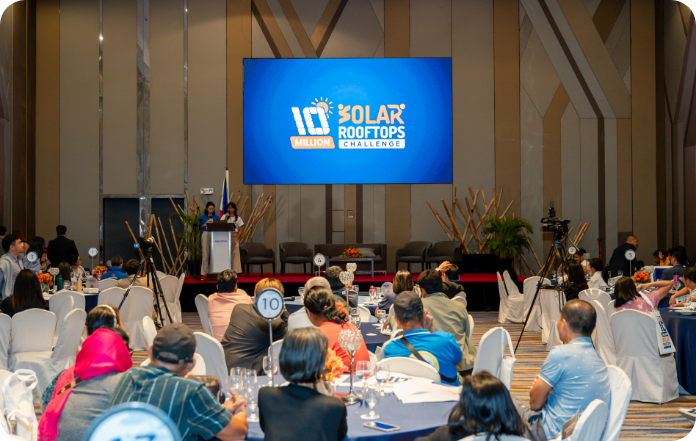
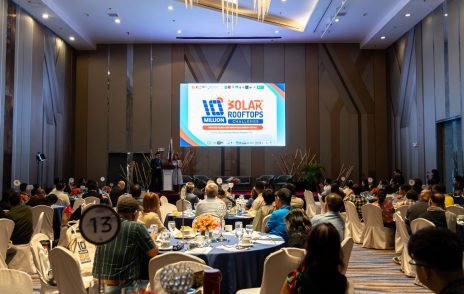
Launched in July 2024, the 10 Million Solar Rooftops Challenge sets a goal for putting up 10 million solar rooftop PV systems across the Philippines through multi-sectoral advocacy and cooperation.
This initiative invites individuals, households, businesses, government bodies, organizations, schools, establishments, Churches, offices, local and national government units, and agencies, to contribute to achieving the 10 million goal through:
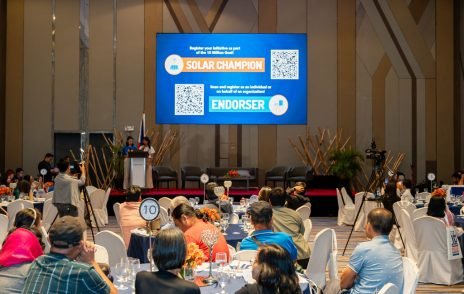
Endorsing the challenge
Raising awareness on the possibilities of distributed renewable energy, especially solar rooftop PV. By creating a community of advocates and champions for distributed renewables, especially solar power, endorsing the challenge is an action that tremendously contributes to advancing the 10 million solar rooftops goal!
Becoming a Solar Champion
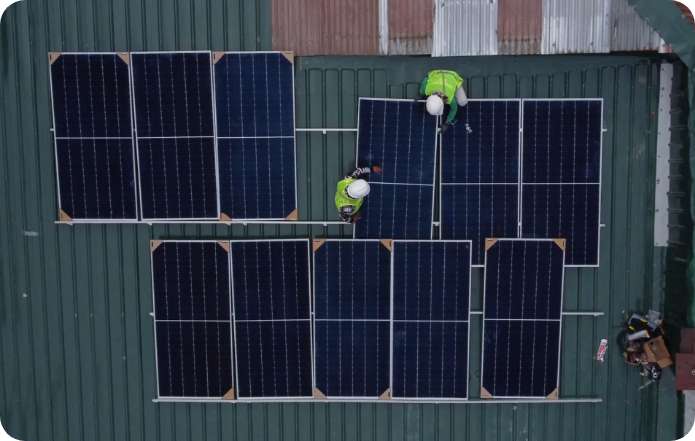
By pledging to invest in and put up your own solar rooftop PV systems, or pursuing programs and projects for solar rooftop PV installations in partnership with others.
With an estimated capacity of 1kW per solar rooftop, meeting the 10 million roofs goal would result in a massive total potential of 10 GW, all directly in our homes and establishments!
With an estimated capacity of 1kW per solar rooftop, meeting the 10 million roofs goal would result in a massive total potential of 10 GW, all directly in our homes and establishments!
What do we hope to achieve?
We envision a movement of Filipinos of all walks of life working together to advance renewable energy - particularly, renewable energy that is directly accessible to and benefiting households, communities, and institutions.
We seek to:

Concretely and meaningfully contribute to the renewable energy transition.

Celebrate the diversity and impact of initiatives to advance solar rooftop PV and distributed renewable energy in communities, cities, and among institutions;

Raise awareness on challenges and opportunities for solar power and distributed renewable energy.

Amplify and ramp up conversations on advancing a just energy transition in the Philippines.

Empower more Filipinos to take part in promoting them.
Why you should join the movement
Renewable energy has an abundant potential and a promising future in the Philippines.
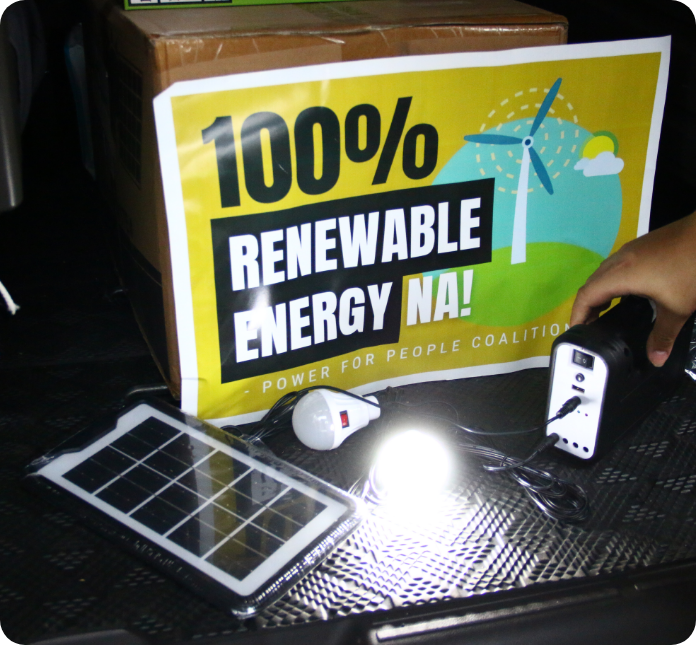
Today, more policies than ever are in place to advance clean and affordable renewable energy - and, across the country, Filipino households, communities, businesses, schools, churches, electric cooperatives, local governments, and many others are taking up the initiative of promoting and even putting up their own renewable energy systems. All these add to the National Government’s current goal of reaching a 35% share of renewables in the Philippines’ power generation mix by 2030.
Latest projections tell us that increasing Filipinos’ access to renewables can happen at even greater speed and scale, with an estimated potential of 1,200 GW just for wind and solar power. Solar PV rooftop alone totals 91 GW - over three times the total installed capacity we currently have nationally. This means that there is a huge potential for putting up solar-powered renewable energy systems directly benefiting Filipino homes, offices, and establishments!
Hastening the deployment of renewable energy is, of course, a matter of great urgency. Even in the aftermath of the Renewable Energy Law, the share of renewable energy (RE) generation decreased from 34% in 2008 to 22% by the end of 2022. In 2022, solar installed capacity stood only at 1.53 GW, accounting for nearly 2% of the total power generation mix.
Today, increased expansion of gas and even threats of lifting the 2020 moratorium on new coal projects risk crowding out the ambitious entry of renewables. This is as the Philippines just experienced its warmest summer on record, quickly followed by the first of our many annual typhoons and super typhoons whose destructive impacts only intensify as the climate emergency worsens.
The good news is that our abundant potential makes it possible to achieve a full renewable energy shift compatible with the 1.5°C Paris Agreement goal on global warming - and there are more opportunities than ever today to advance renewables.
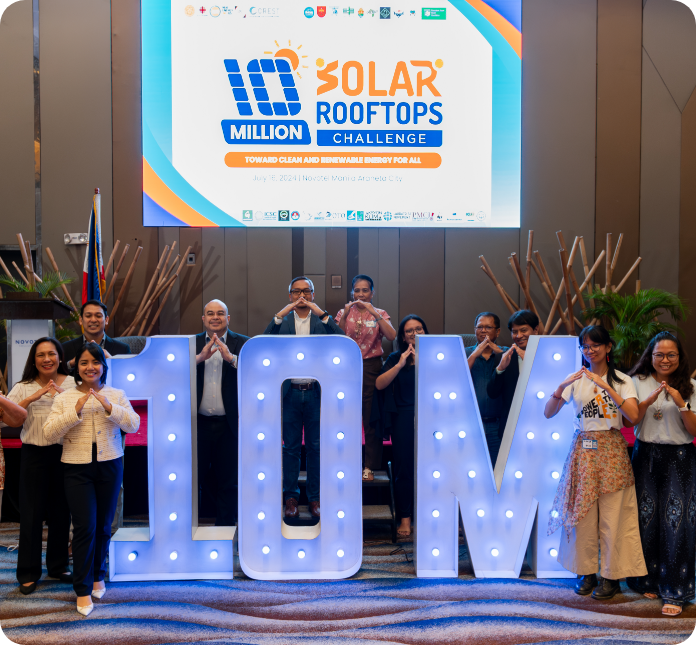
Through the 10 Million Solar Rooftops challenge, we celebrate the transformative power of renewables and initiate a call for a hastened renewable energy shift led by Filipinos of all walks of life.
This campaign is co-convened by:

Solar Stories
The 10 Million Solar Rooftops Challenge celebrates the transformative power of community-based and distributed renewable energy.
Learn more about some of our #SolarStories below:
Endorsed by
Bp. José Araneta Cabantan (CDO)
Archdiocese of CDO
Tara
Member, SAVE PH
Camalanda
NHS
Teddy Baguilat
Green Convergence
Join the Movement
Join the movement for clean and affordable renewable energy for all!
13,347
Committed rooftops
13,189
Rooftops solarized
3093.32 MW
Total installed solar rooftops capacity
12.02%
Residential
371.8 MW
6.91%
Commercial
213.78 MW
81.07%
Utility
2,507.73 MW
As one of our convenors, Institute for Climate and Sustainable Cities (ICSC) has launched their solar mapper, SPECTRUM—a proprietary model and web platform developed to allow users to visualize rooftop solar installations and estimate potential solar capacity across the Philippines.
SPECTRUM automatically identifies solar panel systems and calculates their capacity, enabling smarter, data-driven energy planning and policy development.
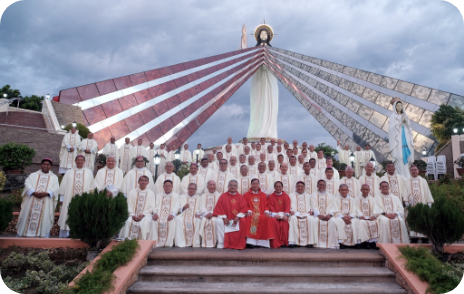
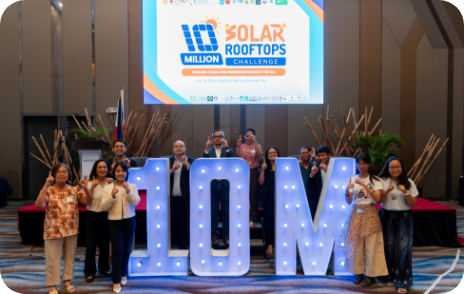
Press Center



Frequently Asked Questions
Our Campaign
The 10 Million Solar Rooftops Challenge seeks to put up 10 million solar photovoltaic (PV) rooftop systems across the Philippines through multi-sectoral advocacy and cooperation. The challenge invites individuals, households, businesses, government bodies, organizations, schools, establishments, Churches, offices, local and national government units, and agencies, to contribute in achieving the 10 million goal.
The 10 Million Solar Rooftops Challenge envisions Filipinos from all walks of life working together to advance renewable energy – particularly, renewable energy that is directly accessible to and beneficial to households, communities, and institutions. Through the challenge, we hope to:
- Concretely and meaningfully contribute to the renewable energy transition through the 10 million solar rooftops installation goal, and send a market and policy signal on the kind of energy that more and more Filipinos want – renewables!
- Celebrate the diversity and impact of ongoing and upcoming initiatives to advance rooftop solar systems and distributed renewable energy in communities, cities, and among institutions;
- Raise awareness of opportunities for solar power and distributed renewable energy, and empower more Filipinos to take part in promoting them; and
- Amplify and ramp up conversations on advancing distributed renewable energy, in contribution to efforts to shape the discourse for a just energy transition in the Philippines.
The campaign was conceived in an effort to address just and clean energy transition in the Philippines. It is not the first initiative of its kind. As early as 2010, Senator Bernie Sanders authored a bill with similar intentions in the United States. The bill intended to lower the cost of solar power and put the United States on track to install 10 million solar rooftops on homes and businesses by 2020. In India, a national campaign was launched by the government in early 2024 in order to install solar rooftops on 10 million households across the country. This was part of a wider initiative dubbed the “Pradhan Mantri Suryoday Yojana” which aims to reduce electricity expenses and increase the country’s self-reliance.
A solar PV panel comprises multiple PV cells that convert sunlight into electrical energy. These cells are the fundamental components of the panel, working together to produce direct current (DC) electricity when exposed to sunlight.
A solar PV system comprises solar PV panel/s and other components such as an inverter, which converts DC into alternating current (AC), mounting systems, wiring, and sometimes a battery or storage system for electricity. This setup is designed to capture, convert, store, and manage solar energy for practical use in residential, commercial, or industrial applications.
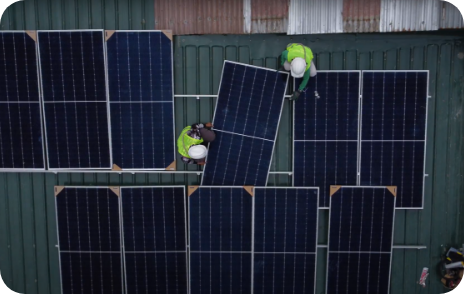
A solar rooftop refers to a solar PV system installed in the rooftop of a structure.
For this challenge, every structure (e.g. house, building) counts as one rooftop. This means that a Solar Champion can have multiple rooftops in one location. For example, a single university that joins the 10 Million Solar Rooftops Challenge and solarizes three campuses, each campus consisting of one building, will contribute three rooftops to the Challenge.
Considering that there are distributed solar PV systems that are community-owned, -based, and/or -managed but have not been installed on rooftops due to roof structural concerns, the Campaign will still count these systems as they contribute to the overall goal of building a movement of Filipinos taking an active role in the energy transition by deploying their own solar PV system.
It depends in various factors such as the size of the solar rooftop installation, the rooftop area, load profile, and of course—the budget.
Typically, urban settings have installations around 5 kilowatts (5 kW), while rural settings use 3 kW systems. However, a baseline calculation of 1 kW per rooftop is used to accommodate different income classes.
Nevertheless, 10 Million Rooftops has an expected estimated 10 GW of installed capacity.
As of May 31, 2024, the Energy Regulatory Commission (ERC) reports that there are 13,189 Qualified End-users (QEs) in the net-metering program with a total capacity of 116,292.14 kW-peak (kWp). Luzon has the highest capacity at 70.79%, followed by Visayas at 24.02%, while Mindanao has the lowest capacity share at 5.19%.
These numbers are used as baseline data for the said challenge. Meanwhile, solar rooftop end-users not enrolled in the net metering program are still encouraged to register and be included in the baseline data.
Of course! A recent study conducted by Climate Analytics on the 1.5°C pathway for the Philippines shows that is entirely feasible for the Philippines. The 1.5°C pathway requires a high and rapid ramp-up of wind and solar energy generation. These renewables are projected to contribute significantly to the overall electricity generation, generating 72% of the country’s electricity by 2030 and 93% in 2050. 1
Another study in 2018, entitled “Greening the Grid,” was conducted by the Department of Energy in partnership with the National Renewable Energy Laboratory (NREL) and the U.S. Agency for International Development (USAID). This study shows that achieving 30% to 50% renewable energy penetration in the power system is feasible in 2030.2
1 “A 1.5°C future is possible: getting fossil fuels out of the Philippine Power Sector (2023)” by Climate Analytics. Read more about it here.
2 “Greening the Grid: Solar and Wind Grid Integration Study for the Luzon-Visayas System of the Philippines” by the Department of Energy. Read more about it here.
1 Climate Analytics (2023). A 1.5°C future is possible: getting fossil fuels out of the Philippine power sector. Accessed from: https://climateanalytics.org/publications/a-15c-future-is-possible-getting-fossil-fuels-out-of-the-philippine-power-sector
2 Department of Energy (2018). Greening the Grid: Solar and Wind Grid Integration Study for the Luzon-Visayas System of the Philippines. Accessed from: https://doe.gov.ph/electric-power/greening-grid-report
The Benefits of Solar Power
Based on Meralco’s January to June 2024 billing, generation rates from a solar power-producing power plant range from 3.121 to 3.3122 PhP/kWh only.
1 Meralco procures from Solar Philippines Tarlac Corp (SPTC) which operates utility-scale solar power.
Savings and energy security are the main advantages of solar PV rooftop systems. In 2022, the Philippines saved up to Php 3.9 billion (US$78 million)1 from the use of solar energy.2
Ateneo de Davao University has installed 1,000 kW of total capacity across its three campuses, saving as much as Php 1.6 million per month.3
According to Philippine Solar Rooftops, a 1kW system can save as much as Php 16,800 a year, a 3kW system can save Php 50,400 a year, and a 5kW system can save Php 84,000 a year.4
1 Assuming that the exchange rate in 2022 was US $1 = Php 50.
Solar rooftops do not necessarily need to be connected to the electricity grid managed by an electric cooperative or private-owned electric distribution company. Off-grid solar PV systems are completely independent of the utility grid or the distribution utility, which can be beneficial in remote locations where grid access is not available or reliable. The choice between grid-tied and off-grid solar systems depends on personal preferences, financial considerations, and the specific energy needs of the household or building.
A residential installation will take 1-2 days.
For higher capacity installations, it will take weeks to complete.
Note that this does not include the surveys needed for the load profile and rooftops.
Solar Rooftops are dependable enough that in the event of grid disruptions due to natural disasters or other emergencies, such as super typhoons and floods that can bring down electric cables, solar PVs can provide evacuation centers and homes with a viable source of electricity for weeks until power is restored.
Solar rooftops offer a decentralized form of power generation, which can be less vulnerable to large-scale outages that affect bigger power plants.
With this, solar rooftops are an important investment especially for LGUs, evacuation centers, and hospitals that need consistent, steady power source during calamities.
Other than being an investment and energy security, solar rooftops also serve as insulation from heat by absorbing sunlight.
This helps to reduce the amount of heat that enters the house or building, ultimately lowering cooling costs and creating a more comfortable indoor environment.
Additionally, solar panels can provide some degree of noise insulation by lessening the sound of raindrops during a downpour. This is because the panels can absorb and dampen the sound before it reaches the interior of the building.
3 Meralco procures from Solar Philippines Tarlac Corp (SPTC) which operates utility-scale solar power..
4 Assumed exchange rate US$1 = Php 50
5 Dela Peña, Kurt. Solar energy delivers $78M in savings for coal addict PH. The Philippine Daily Inquirer. 15 November 2022. Available at: https://newsinfo.inquirer.net/1693639/solar-energy-delivers-78m-in-savings-for-coal-addict-ph. Accessed on 11 June 2024.
6 CCC JCAP Flagship Project. From Fossil Fuel Dependence to Renewable Energy Reliance: The Story of Ateneo de Davao University. Accessed from https://www.youtube.com/watch?v=PONvX-MvaX0
7 Philippine Solar Rooftops. https://www.solarrooftops.ph/
The Welcoming Environment for Solar Rooftops Today
Yes, the Philippines promotes solar rooftops through The Renewable Energy Act of 2008.
The Act promotes the development and utilization of renewable energy resources, including solar rooftops. It provides a framework for the accelerated development and advancement of renewable energy resources, with specific provisions that facilitate the installation of solar PV systems on rooftops. The Department of Energy has established policies and frameworks to encourage the expanded use of solar rooftop systems. One of the key mechanisms introduced is net metering, which allows consumers to generate their own electricity from solar PV systems and sell any excess back to the grid.
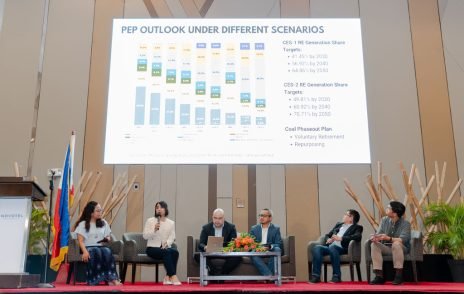
This is in line with the country’s goals to increase the share of renewable energy in its total electricity generation to 35% by 2030 and 50% by 2050, as reflected in the newly released Philippine Energy Plan 2023-2050. Under the Reference scenario of PEP, solar installed capacity is projected to reach 56.478 GW by 2050.
Yes, there is no policy, law, or rule that prohibits the installation of solar rooftops for own-use today.
No, the installation and operation of solar PVs do not require a license. However, there are options for solar rooftop owners to register their system to enjoy additional benefits.
The owners of solar PV systems with capacity below 100kW may apply for net-metering with their DUs. If the solar PV system has a capacity that is above 100kW and below 1MW, the system may be eligible under the Rules for the Distributed Energy Resources (DERs).
Prices of solar panels and accessories continue to have a downward trend. The government also provides for tax incentives and exemptions regarding the use of solar energy. For example, in Iloilo City, residents can avail of a 20% annual discount on their basic real property tax through house solarization.1 Quezon City passed an ordinance that offers tax credits on green buildings. Government agencies such as the Bureau of Internal Revenue and the Board of Investors also provide incentives to corporate entities developing and/or utilizing renewable energy.2
The ERC has provided for rules regarding net-metering in order to allow solar PV users to sell excess energy back to the power grid. In the Meralco franchise, from January 2024 – June 2024, the generation price for net-metering ranges from Php 6.5044/kWh to Php 7.0988/kWh, or an average generation price of Php 6.7/kWhz.3
Under the net-metering program, any electricity generated that is not consumed by the customer is automatically exported to the DU’s distribution system. The DU then gives a peso credit for the excess electricity received equivalent to the DU’s blended generation cost, excluding other generation adjustments, and deducts the credits earned to the customer’s electric bill.1
Consumers of DUs who are in good credit standing in the payment of their electric bills are qualified to participate in the net-metering program of their DU. Applications for a net-metering agreement with the DU may be processed through the DU along with the other regulatory requirements.
Other regulatory requirements include electrical permits and certificates of final electrical inspection which may be obtained from the city or municipal hall. Depending on the assessment, the DU may also require a distribution impact study for the solar PV system.
1 How net-metering works: Understanding the basics of policy, regulation and standards. Read more here.
There are a lot of solar companies providing EPC (engineering, procurement and construction) and installation services. We recommend engaging companies with the necessary legal permits, has a good track record, and in the DOE’s list of solar PV installers.
Every component of the solar PV system has a different lifespan. On average, the components enumerated below have the following lifespans:
- Solar Panels – 25-30 years1
- Inverters – 10-15 years2
- Lead-Acid Batteries – 5 years3
- Lithium Ion Batteries – 10 years4
8 Rappler 2024. Iloilo City offers incentives to households shifting to solar power. Accessed from https://www.rappler.com/philippines/visayas/iloilo-city-government-offers-incentives-households-shifting-solar-power/
9 DENR. DENR lauds QCs “green” building ordinance. Accessed from: https://denr.gov.ph/news-events/denr-lauds-qcs-green-building-ordinance/
10 MERALCO. Generation January 2024 to June 2024. Accessed from: https://company.meralco.com.ph/news-and-advisories/rates-archives (The ordinance is also in the process of undergoing amendments)
11 DOE. How Net-Metering works: understanding the basics of policy, regulation and standards. Accessed from: https://doe.gov.ph/1-how-net-metering-works-understanding-basics-policy-regulation-and-standards
12 Forbes. How Long Do Solar Panels Last?. https://www.forbes.com/home-improvement/solar/how-long-do-solar-panels-last/
13 PV-Magazine. How long do residential solar inverters last?. https://www.pv-magazine.com/2024/07/24/how-long-do-residential-solar-inverters-last-4/
14 Plico. How Long Do Solar Batteries Last? And What Impacts Their Lifespan? https://www.plicoenergy.com.au/blog/how-long-do-solar-batteries-last
15 Solar. How Long Does a Solar Battery Last? https://www.solar.com/learn/how-long-does-a-solar-battery-last
Becoming a Solar Champion
Step 1: Contact an accredited Solar PV Installer. Aside from the DOE list, you can also check http://app.yuda.com, and the members of the Philippine Solar and Storage Energy Alliance (PSSEA) or the Association of Solar Installers of the Philippines (ASIP).
Make sure you check their website or social media pages for proof of transaction and customer reviews. Verify if they have good reviews from previous customers — the quality of the products they used, their responsiveness, and after-sales support.
**If it is a sizable project, you may want to consider a proper procurement process where several solar providers will provide a quotation on the system. Request for the necessary documents such as their business registration, sample invoices, engineering licenses and NC II certification of the installation team.
Step 2: Upon contacting and setting the schedule for inspection of the intended structure to be solarized, the Solar Provider should conduct an electricity audit of the same. Ideally, you are able to provide your previous electricity bills, electrical plan, and other documents necessary for the solar installer to assess the feasibility of the project.
Step 3: The Solar Provider must survey the roof structure to ensure its strength of withholding a solar PV. They will also be inspecting if there are possible challenges in the installation e.g. accessibility, wiring, etc.
Step 4: The Solar Provider will give a quotation of the costs for the solar PV installation. Understand the cost drivers for the system such as the brand of the products, product warranties, workmanship warranties, insurance (if any), service inclusions such as net metering application and other LGU permits.
Step 5: Fully understand the details of the quotation. Remember that good quality comes with a cost. Gauge the responsiveness of the installer as it will be critical to maintain regular communication with them.
One solar PV provider has developed a Solar Panel Cost Calculator that can estimate the solar PV system for your own use and your possible monthly savings. While other solar PV installers provide the following estimates for different grid-tied solar rooftop systems:
|
Solar Rooftop System |
Estimate Cost |
|---|---|
|
400-500Wp Grid-Tied |
Around Php 65,000 – Php 80,000 |
|
1.57 kWp Grid Tie Solar
|
Around Php 105,000 – Php 127,000 |
|
3.15 kWp Grid Tie Solar
|
Starts at Php 183,000 |
|
5.04 kWp Grid Tie Solar
|
Starts at Php 220,000 – Php 250,000 |
Estimates can vary depending on the brand of the solar PV and other factors. We suggest that you ask for quotes and if possible conduct a competitive bidding among possible providers.
The DOE suggests the following options in order to finance solar PVs:1
- Term loan from the bank;
- Leasing either through a direct lease of equipment or sale and lease back of equipment;
- Philippines Sustainable Energy Finance Program, an investment and advisory program implemented by the International Finance Corporation which is an avenue for lending to energy efficiency and renewable energy projects;
- Loan Window for Net-metering project of the Development Bank of the Philippines; and
- Environmental Development Project of the Japan International Cooperation Agency.
1 How to Finance Solar Rooftops. Read more here.
Banks and financing institutions have also rolled out various financing programs for the purchase and installation of solar PV systems, both for individuals and businesses. Some of these loan/mortgage programs are listed as follows:
- Pag-Ibig Housing Loan for the Acquisition/Installation of Solar Panels1
- The Solar Mortgage Program by the Bank of the Philippine Islands2
- The Solar Merchant Power Plant Program (SMPP) by the Development Bank of the Philippines3
1 An Act Institutionalizing Energy Efficiency and Conservation, Enhancing the Efficient use of energy, and granting incentives to Energy Efficiency and Conservation Project. Read more here.
2 BPI’s Solar Mortgage. Read more here.
3 DBP’s Solar Merchant Power Plant (SMPP) Financing Program. Read more here.
Every solar rooftop installation takes us closer to the 10 million solar rooftops goal! If your organization has the capacity or plans to pursue programs and projects for solar rooftop PV installations in your own facilities or with partners, register it as part of the 10 million goal here.
If you have already put up your own solar rooftop and want this to be counted as part of the 10 million goal, you can sign it up in our tracker here. You can even share stories of how becoming a Solar Champion has made clean and affordable renewable energy directly accessible to and benefiting households, communities, and institutions.
You can also share stories of how becoming a Solar Champion has made clean and affordable renewable energy directly accessible to and benefiting households, communities, and institutions.
Send us your Solar Champion stories today!
16 SolarLab. Solar Panel Price in the Philippines. https://solarlab.ph/solar-panel-price-philippines/
17 Solaric. Solar Panel Installation Cost: Get A Quote. https://solaric.com.ph/solar-panel-installation-cost/
18 Ibid.
19 Ibid
20 DOE. How to finance Solar rooftops. Accessed from: https://doe.gov.ph/6-how-finance-solar-rooftops
21 https://www.pagibigfund.gov.ph/document/pdf/announcement/Pag-IBIG%20Energy%20Conservation%20Measures_v03.pdf
22 https://www.bpi.com.ph/personal/loans/housing-loan/solar-mortgage
23 https://www.dbp.ph/developmental-banking/infrastructure-and-logistics/solar-merchant-power-plant-smpp-financing-program/
Endorse and follow the 10 Million Solar Rooftops Challenge
To become an endorser, we ask that you, your community, organization and/or institution to provide and post publicly the support for the goal to put up 10 Million Solar Rooftops nationally through a multisectoral approach.
Your endorsement will be reflected in the 10 Million Solar Rooftops Challenge communications platforms and initiatives.
As an endorser, we highly encourage you to publicize your support and the significance of the campaign in whatever way possible to you. This can vary from airing in traditional medial channels, posting it on your digital platforms and pages, sharing the 10 Million Solar Rooftops Challenge in public events or simply, just talking to your friends and family about it!
Most importantly, as an endorser, we have a common goal to help everyone know that we want a renewable-powered future.
Endorse the Challenge here.
1 Climate Analytics (2023). A 1.5°C future is possible: getting fossil fuels out of the Philippine power sector. Accessed from: https://climateanalytics.org/publications/a-15c-future-is-possible-getting-fossil-fuels-out-of-the-philippine-power-sector
2 Department of Energy (2018). Greening the Grid: Solar and Wind Grid Integration Study for the Luzon-Visayas System of the Philippines. Accessed from: https://doe.gov.ph/electric-power/greening-grid-report
3 Meralco procures from Solar Philippines Tarlac Corp (SPTC) which operates utility-scale solar power..
4 Assumed exchange rate US$1 = Php 50
5 Dela Peña, Kurt. Solar energy delivers $78M in savings for coal addict PH. The Philippine Daily Inquirer. 15 November 2022. Available at: https://newsinfo.inquirer.net/1693639/solar-energy-delivers-78m-in-savings-for-coal-addict-ph. Accessed on 11 June 2024.
6 CCC JCAP Flagship Project. From Fossil Fuel Dependence to Renewable Energy Reliance: The Story of Ateneo de Davao University. Accessed from https://www.youtube.com/watch?v=PONvX-MvaX0
7 Philippine Solar Rooftops. https://www.solarrooftops.ph/
8 Rappler 2024. Iloilo City offers incentives to households shifting to solar power. Accessed from https://www.rappler.com/philippines/visayas/iloilo-city-government-offers-incentives-households-shifting-solar-power/
9 DENR. DENR lauds QCs “green” building ordinance. Accessed from: https://denr.gov.ph/news-events/denr-lauds-qcs-green-building-ordinance/
10 MERALCO. Generation January 2024 to June 2024. Accessed from: https://company.meralco.com.ph/news-and-advisories/rates-archives (The ordinance is also in the process of undergoing amendments)
11 DOE. How Net-Metering works: understanding the basics of policy, regulation and standards. Accessed from: https://doe.gov.ph/1-how-net-metering-works-understanding-basics-policy-regulation-and-standards
12 Forbes. How Long Do Solar Panels Last?. https://www.forbes.com/home-improvement/solar/how-long-do-solar-panels-last/
13 PV-Magazine. How long do residential solar inverters last?. https://www.pv-magazine.com/2024/07/24/how-long-do-residential-solar-inverters-last-4/
14 Plico. How Long Do Solar Batteries Last? And What Impacts Their Lifespan? https://www.plicoenergy.com.au/blog/how-long-do-solar-batteries-last
15 Solar. How Long Does a Solar Battery Last? https://www.solar.com/learn/how-long-does-a-solar-battery-last
16 SolarLab. Solar Panel Price in the Philippines. https://solarlab.ph/solar-panel-price-philippines/
17 Solaric. Solar Panel Installation Cost: Get A Quote. https://solaric.com.ph/solar-panel-installation-cost/
18 Ibid.
19 Ibid
20 DOE. How to finance Solar rooftops. Accessed from: https://doe.gov.ph/6-how-finance-solar-rooftops
21 https://www.pagibigfund.gov.ph/document/pdf/announcement/Pag-IBIG%20Energy%20Conservation%20Measures_v03.pdf
22 https://www.bpi.com.ph/personal/loans/housing-loan/solar-mortgage
23 https://www.dbp.ph/developmental-banking/infrastructure-and-logistics/solar-merchant-power-plant-smpp-financing-program/
FAQs by: Center for Energy, Ecology, and Development with contributions from Center For Renewable Energy and Sustainable Technology.
Contact Us
For any inquiries, send us an e-mail at 10msolarrooftops@gmail.com.
Stay updated on latest articles and developments by following us on facebook.com/10millionsolarPH